Every Piece of Land Comes With Its Own Instructions. A Rant.
The idea that things are separable from the land , separable from place, because they live inside of you? That is a colonial understanding of what Indigenous traditions actually teach you. About all that you are, and all that you bear, and all that you can make. A lot of times, one of the biggest humps to get over is for people to understand that culture, religion, language — all of these things, all of these methods of translating as best we can our experiences of being alive on this earth — are completely tied to place. Not metaphorically, and not poetically. I mean TIED. Rooted. Beholden. And if you don't believe me, let's go macro and then go micro.

This image provided by NASA shows a downlink image of Earth taken by NASA’s Artemis II astronaut commander Reid Wiseman inside the Orion capsule on Friday, April 3, 2026 [NASA via AP]
None of This Means Anything Off This Planet.
Start at the largest scale you can hold in your mind. Think the whole, wide, world. The planet. None of this is relevant outside of this planet. Period. If there are aliens somewhere out there, they don't give a damn about our politics or religions. All of this — every tradition, every altar, every prayer, every way we have ever tried to make meaning out of being alive — is relevant to this planet. Of this place. With rock and water, and things in between that we live on.
And we have to sit with that. Because even our most transcendent spiritual systems, the ones that try to point us toward something beyond this world, are built from the materials of this world. The metaphors are earthly., the rituals use water, fire, earth, flesh. The divine, however we name it, gets translated through the specific conditions of life on this specific watery rock. There is no other planet in our solar system with ecosystems like ours. No other planet in our solar system with humans, as far as we know. No other planet in our solar system where the particular web of animal life, plant life, social life, grief, joy, and memory that we know is happening. Our religions, our traditions, our cultures, our thoughts, our politics — all of it is completely beholden to this place. Everything we do is place-based.
Now, come all the way back down.
Your memory has an address.
There are things that live in our bodies: memory and rememory. There is the intrinsic adaptation of long lines of genealogical inheritance that shows up in ways Western science can barely name, that Indigenous science strives even closer to speak about. Those things are real, living in us, and finding us constantly. But here is the thing people miss: even your memories, even the most interior and private of them, are place-based. Because they are inside of you. And you are a place. A body is a place. A person is a location in the world.
What we are talking about, when we talk about embodied knowledge, is not simply that the body stores what the mind forgets. We are talking about a dynamic, ongoing negotiation between what you carry and where you stand. The body does not just remember, it remembers in relation to ground. To water. To moon phases. To the specific air of a specific place. Your knowing is always a translation of what you hold inside you, which has its own past/present/future, meeting the land you are standing on, which has its own past/present/future. That meeting is continuous. You are always (whether you know it or not) making time and space out of that encounter. In this very moment you stand on land that has it’s own demands. Every set of land comes with its own instructions.
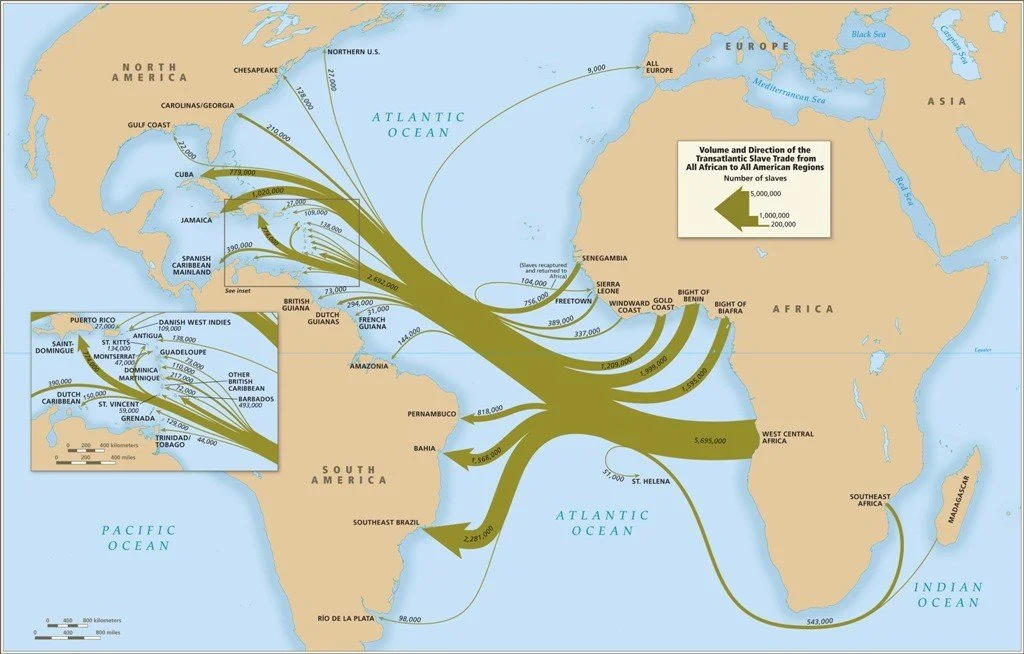
Map of Atlantic Slave Trade Movements
The Diaspora: Intrinsic, But Never Divorced From Land
For those of us of the African diaspora, this reality is not an abstraction. We live it in ways we’ve been speaking, singing, dancing, and praying about for nearly half a millenia. There are things intrinsic to us — memories embedded not only from ancestors centuries ago on the African continent, but from ancestors who lived and died on this “American” continent specifically, on this soil, and who left particular marks in our cellular and spiritual inheritance. There are things in us that colonialism tried to destroy and could not. And those things are a method of finding each other, of continuing a spirit, of insisting on our own existence.
But — and this is the part that gets flattened in some conversations about diaspora identity — that inheritance is never divorced from the land you are currently standing on. The question of what it means to be of African descent is not a question with one answer that travels. It is a question that the land keeps answering differently. Someone of the African diaspora living in Chicago is going to have a different way of translating and living their life than someone living in Rio de Janeiro. Not because one is more authentic than the other. Because the land is different. Chicago has the Great Lakes, Rio de Janeiro has the Atlantic Ocean and Baía de Guanabara — and that changes things. The specific weight of those places, what they have witnessed, what they carries in their waters and its soil and its buried dead , all of that changes how you understand yourself, how you understand your community, how tradition moves through you.
And we have to reckon with what these lands bear. The weight of colonialism is not only a weight on people. It is a weight on land. The land has absorbed the most inhumane, monstrous things in human history . Absorbed them into itself, the way land does and that changes the instructions the land gives. The land is not neutral. It never was. And the people who have lived on it, survived on it, loved on it in conditions of terror, have had to learn to read those changed instructions and adapt. That is not tragedy only, that is also genius. That is also what it looks like when a people refuses to be destroyed.
So, here is a concrete example of what place-based knowing actually does to a tradition. There are some (continental) African Traditional Religions that teach you should not place people who died by violent means on an ancestral altar or materials like it. That certain deaths make someone spiritually untouchable in that ritual context. Those traditions have their reasons and their wisdom, and I am not here to argue with them from the inside. That is not mine to do. But then you come over here. To this land. To Turtle Island. To the Americas. To the diaspora. To what is now known as the United States. And you bring that framework and you hold it up against the reality of what has happened here and what is still happening, you have to reckon with the fact that if we were to disregard everyone who died tragically, we would disregard everyone who died here (and on the way to here). Because all of this over here is tragic. Everyone in this diaspora dies as a result of white supremacy, it is just a matter of whether it gets you sooner or later, and how much love and joy you could find in between.
And so in Hoodoo — and let me stay in what I know — we honor our ancestors, the people whose life gave them the means of being worthy of reverence, and it’s not stipulated through their means of death. We honor Martin Luther King. (assassinated). We honor Malcolm X (assassinated). We honor Fred Hampton (assassinated). We honor Sandra Bland (lynched). We honor Breonna Taylor (shot while sleeping). We honor all of them. The tradition listened to the land it was on and it adapted. That is survival wisdom is what living traditions do.
Even the question of suicidality shifts here. Think about Igbo Landing. Think about Margaret Garner and her original plans. Think about Kalief Browder. What these people faced, what brought them to those moments, is not a moral failing to be tucked away and not named. It is understandable given what has been endured on this land. And the land itself does not treat them as taboo. The land takes them in. Because the land also understands. Because the land has also been through something. The land and the people have been through it together and the land knows and holds what we cannot always hold for each other.
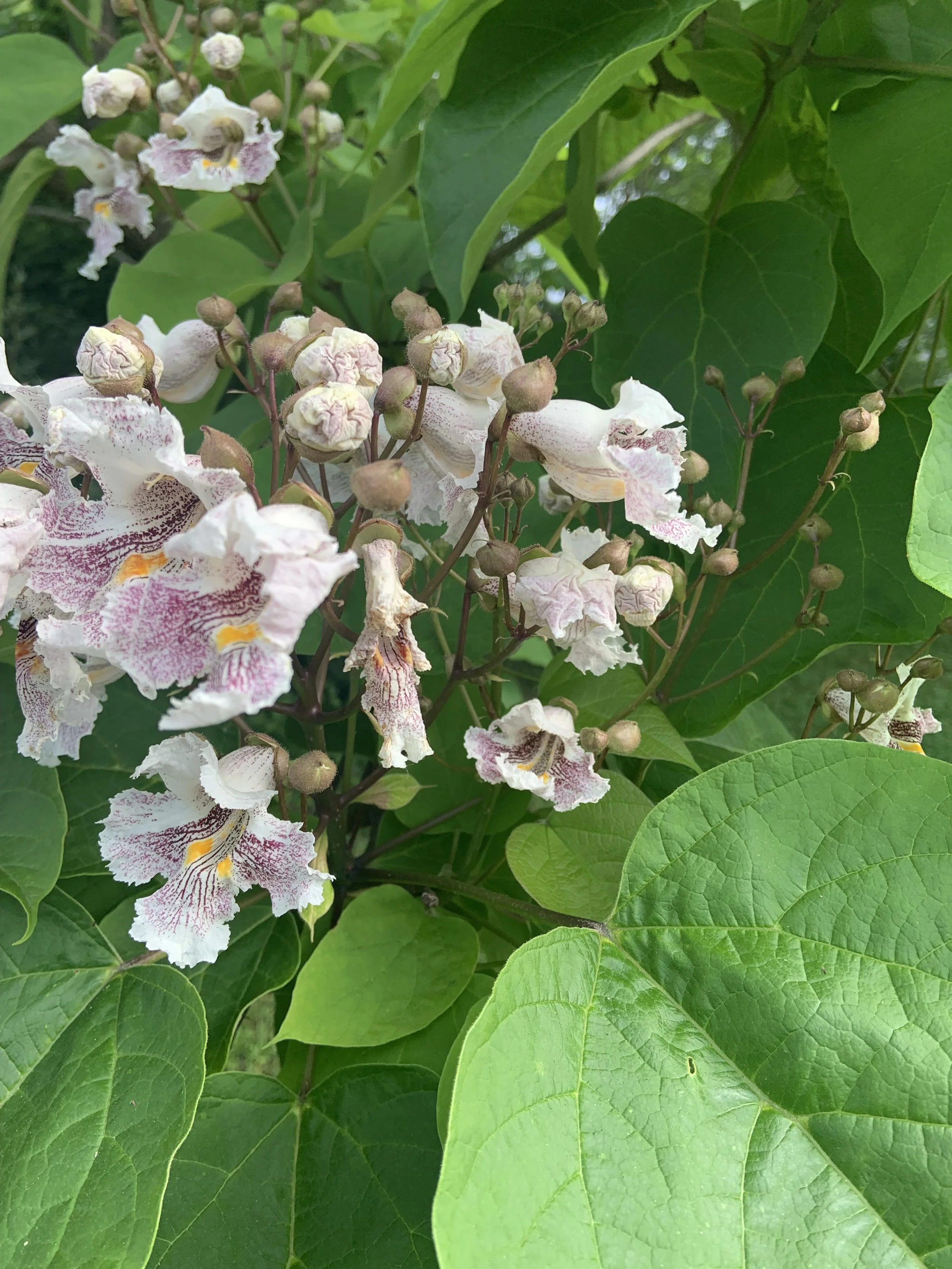
Place is not backdrop. Place is the condition of everything we know and everything we are. The land has always been speaking, we were just taught not to listen.
Now. There is a trap. And it catches a lot of people who are genuinely trying to find their way back to something that colonialism did not build and cannot own. Sometimes people just be so stuck. Sometimes people figure that the medicinal thing to do is to be the extreme opposite of everything this world is. Thinking that's going to bring balance. It's not. The extreme opposite of colonialism it is still colonialism setting the terms. It is still the master's framework drawing the map, just with you on the other side of it. You are still inside the binary that colonialism constructed, you are still letting it define the poles.
I want to be careful here because sometimes the extreme opposite is exactly what justice requires. Sometimes you have to go there. But there is a difference between going there as a strategic necessity and living there as a permanent address. So many people live in such constant opposition that they become unable to hear anything that doesn't fit the fight. They can't hear ancient teachings from traditions older than colonialism. They can't hear sustainable and ancestral teachings that were forced to be born because of colonial conditions but that exist as a response to that to help us keep ourselves right, to help us stay whole in conditions designed to shatter us.
“Revolution begins with the self, in the self…It may be lonely. Certainly painful. It’ll take time. We’ve got time. That of course is an unpopular utterance these days. Instant coffee is the hallmark of current rhetoric. But we do have time. We’d better take time to fashion revolutionary selves, revolutionary lives, revolutionary relationships. Mouth don’t win the war. It don’t even win the people. Neither does haste, urgency, and stretch-out-now insistence. Not all speed is movement.”
Indigenous traditions across this planet teach about balance. About temperance, levity, and the fact that yes, you can exact justice, and also that you have to understand enough about what you're dealing with before you move. The teaching is the key. But you have to be still enough to receive a teaching, and a lot of people are not still, they are reactive. And reactive is not the same as responsive. Reactive keeps you inside what colonialism built for you. Responsive is how you find your way to something truer and more sustaining.
Talk of sustaining brings this conversation back to the land it never left. The land has so much to say. A book I typically recommend (I'm going to say upfront that it is problematic in places, so don't come back to me with that, I already know — but it has things in it worth sitting with. You chew the meat, you spit out the bones. That kind of book.) It is God Is Red by Vine Deloria Jr. I recommend it constantly because when it comes to this land and the instruction and the understanding of place, our Indigenous to here folks — Indigenous Americans, Indigenous Turtle Islanders, the myriad nations and tribes and peoples who are the original stewards of this land, up and down, coast to coast, pole to pole — their teachings are not decorative, they are a whole epistemology. A whole way of knowing that the rest of us, living on this land, need to be in genuine relationship with. We are on indigenous land. And more than saying it, more than echoing that sentiment via a land acknowledgment, we have to ask what it actually means for how we think, what we practice, what we are open to receiving. The teachings of the original stewards of this specific land are relevant to us. We are on the land too, the land is talking to us too.
We are intrinsically place-based. We always were. It is colonialism that convinced everyone you could pack up your culture like furniture and haul it to a new location and reassemble it exactly as it was. You cannot. No. You cannot. Each piece of land, each blade of grass, each bird, each grain of sand, each thing that grows and breathes and dies in a place comes with its own instructions. And it is human-centric, colonial, to believe that those instructions don't reach you. That they don't move through you. That they don't, by moving through you, move into your family, your community, your culture, your religions, your traditions, your nation.
Because they do.
They absolutely do.
The only question is whether you are paying attention.
